Quick Answer: AEO for B2B means becoming the answer that ChatGPT, Claude, and Perplexity cite, and it runs on four plays: owning adjacent categories, paying affiliates for content refreshes that inject your data into the sources AI scrapes, optimizing G2, Capterra, and TrustRadius profiles for the questions users actually ask, and seeding social signals on X and Reddit. Measure it with four KPIs (Share of Voice, Sentiment, Salience, Mentions) and correlate each content push to the KPI delta it causes. Commercially, expect hybrid deals: flat fees for content work plus performance kickers tied to visibility.
The B2B buying journey has changed. Your prospects aren't just Googling keywords anymore; they are having conversations with AI. Whether it's ChatGPT, Claude, or Perplexity, "Answer Engines" are becoming the new gatekeepers of B2B discovery.
At Jolly Consulting, we've spent years mastering the affiliate ecosystem for complex sales. Now, we are opening a new chapter: AEO (Answer Engine Optimization) Services.
If you aren't optimizing for the machine's answer, you're invisible. Here is how we approach AEO, how you should measure it, and why the economics look different than traditional affiliate marketing.
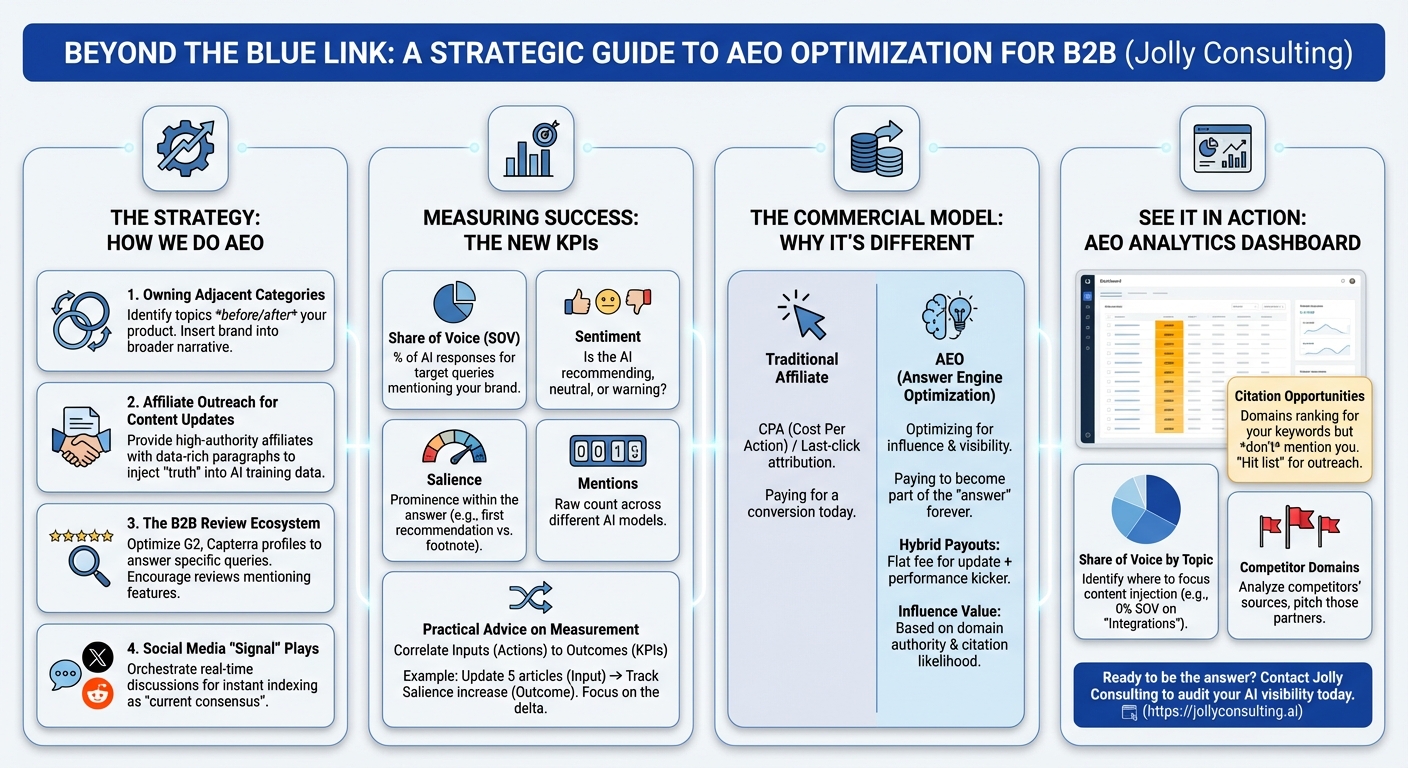
The Strategy: How We Do AEO
AEO isn't about keyword stuffing; it's about brand authority and information density. To get cited by an LLM, your brand needs to be the most credible part of the training data or the live-retrieved context. Here is our high-level playbook:
1. Owning Adjacent Categories
Most brands fight tooth and nail for their core category (e.g., "Best CRM"). But AI answers are often synthesized from broader contexts. We identify "adjacent categories"—topics your customer cares about before or after they need your product—and insert your brand into that narrative. By securing mentions in authoritative content surrounding your niche, we train the engines to associate your brand with the solution.
2. Affiliate Outreach for Content Updates
This is where our affiliate roots shine. We don't just ask partners for a banner ad. We reach out to high-authority affiliates and content creators with "content refresh" packages. We provide them with updated, data-rich paragraphs that specifically answer common questions your prospects ask AI. We aren't just building backlinks; we are injecting your "truth" into the source material that AI tools scrape.
3. The B2B Review Ecosystem
LLMs rely heavily on aggregated sentiment from review sites (G2, Capterra, TrustRadius) to verify claims. We execute specific campaigns to ensure your presence on these platforms isn't just "active," but explicitly phrased to answer the types of questions users ask. We optimize your profile text and encourage reviews that mention specific features AI users query.
4. Social Media "Signal" Plays
Real-time platforms like X (Twitter) and Reddit are often indexed instantly by engines like Perplexity or Google's SGE. We orchestrate social conversations and "expert" threads that discuss your solution in detail, creating fresh signals that these engines pick up as "current consensus."
Measuring Success: The New KPIs
You can't manage what you can't measure. In the world of AEO, "rankings" don't exist in the traditional sense. Instead, we track four core KPIs:
- Share of Voice (SOV): The percentage of AI responses for your target queries where your brand is mentioned.
- Sentiment: Is the AI recommending you, neutral towards you, or warning users away?
- Salience: A score (1-10) of how prominent your brand is within the answer. Are you the first recommendation, or a footnote?
- Mentions: The raw count of times your brand appears across different AI models.
Practical Advice on Measurement
Data without correlation is noise. To actually move the needle, you must correlate inputs (your actions) to outcomes (the KPIs).
- Example: If we update 5 major affiliate articles on Monday (Input), we need to track if your Salience score on Perplexity increases for related queries by Friday (Outcome).
- If we launch a campaign on Reddit regarding a specific feature, does the Sentiment in ChatGPT shift from "Neutral" to "Positive" for that feature over the next month?
We don't just look at the dashboard; we look at the delta caused by our work.
The Commercial Model: Why It's Different
Traditional affiliate marketing is often CPA-based (Cost Per Action) or "last-click" attribution. AEO requires a shift in thinking.
Because we are optimizing for influence and visibility rather than a direct click-through, the payout model changes. You aren't paying for a conversion today; you are paying to become part of the "answer" forever.
- Hybrid Payouts: We often structure deals that combine a flat fee for the "content update" (the work required to update the affiliate's page for AEO) with a performance kicker based on visibility metrics or assisted conversions.
- Influence Value: We value partners based on their domain authority and likelihood to be cited by AI, not just their immediate traffic.
See It In Action
We believe in radical transparency. To help our clients visualize this invisible battleground, we've built a dedicated AEO analytics dashboard.
How to optimize using this data:
If this were your company's data, here is exactly what we would do:
- Check "Citation Opportunities": Look at the table on the dashboard. See those rows highlighted in amber? Those are domains that are ranking for your keywords but don't mention you yet. That is our "hit list" for affiliate outreach.
- Analyze "Share of Voice by Topic": If you are dominating the "Pricing" topic but have 0% SOV on "Integrations," we know exactly where to focus our content injection strategy.
- Monitor "Competitor Domains": The dashboard flags competitors in red. We analyze their sources to see which affiliates are feeding their visibility, and then we go pitch those same partners.
Ready to be the answer?
The shift to AEO is happening now. Contact Jolly Consulting to audit your AI visibility today.